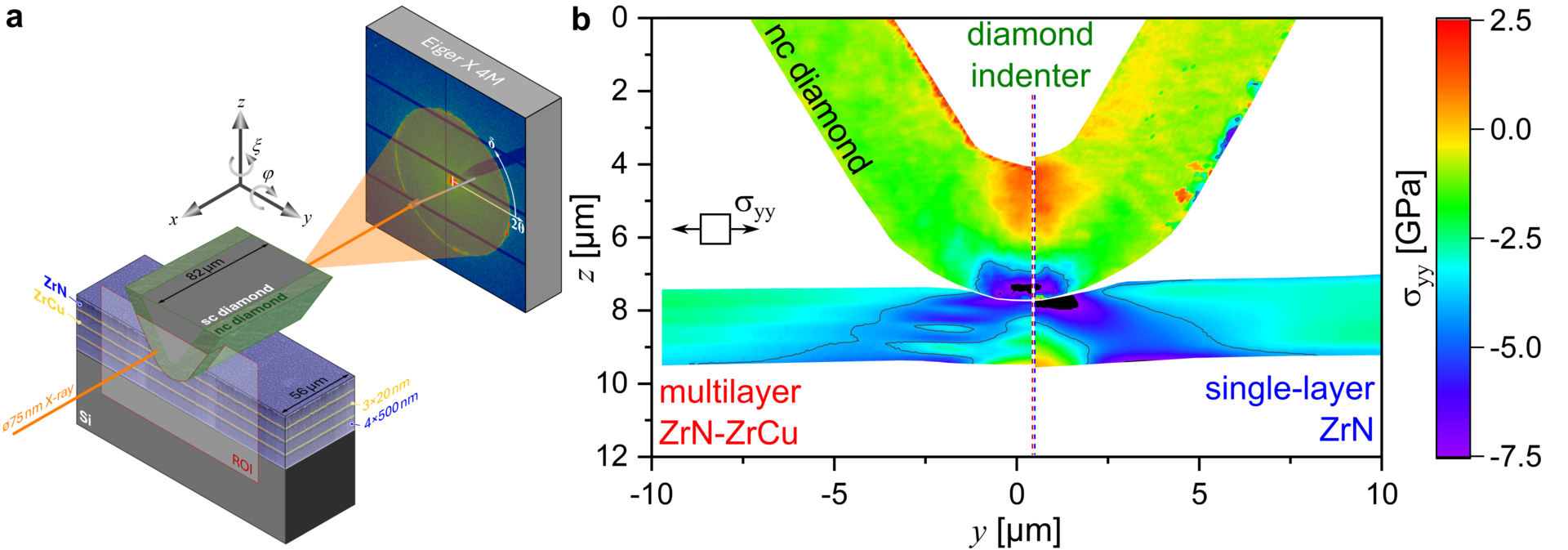
A team surrounding Michael Meindlhumer managed to publish their newest work concerning the fundamentals of the single-asperity contact and the influence of interfaces on the failure behavior of nanostructured thin films under realistic mechanical loading conditions in the prestigious Nature-journal ‘Communications Materials’. The paper entitled „How Interfaces Limit Nanoscale Stress Concentrations and Prevent Catastrophic Failure in Single-Asperity Contacts“ resolves for the first time experimentally the nanoscale stress concentrations on both sides of the single-asperity contact. Furthermore, the influence of interfaces on the ZrN-ZrCu thin film deformation behavior was investigated
To achieve this feat, two in situ indentation experiments were carried out at the ID13 Nanofocus Beamline of the European Synchrotron Radiation Facility (ESRF) with a spatial resolution of 80 nm. In order to investigate the influence of stress concentrations following the single-asperity contact in both, the indenter tip and the sample, the wedge indenter tip was coated with nanocrystalline diamond using chemical vapor deposition (CVD). Thereby, the indenter tip is transformed into a nanomechanical probe, which allows to resolve the stress concentrations in the single asperity contact with nanoscale resolution.
Two thin films based on ZrN were mechanically loaded using that modified indenter tip, namely monolithic ZrN and multi-layered ZrN-ZrCu with three 20 nanometers thin ZrCu metallic glass interlayers. The fact that conventional micromechanical testing yielded no difference in the mechanical properties between these two thin film systems makes them especially interesting for this work.
In the in situ experiments it could be resolved that the ZrCu interlayers reduce the stress concentrations by 30% under load and thus prevent the catastrophic failure of the ZrN-based thin films. In detail, one third of the stored elastic energy compared to the monolithic ZrN is dissipated by plastic deformation of the ZrCu, which prevents crack growth across the substrate-thin film interface.
The fundamental results of this work have great potential influence on the design of modern, technologically relevant thin film systems, since a better understanding of the deformation behavior of multi-layered thin films under realistic loading conditions was achieved.
Permanent link to the work: https://doi.org/10.1038/s43246-026-01239-1
Picture: In (a), a schematic of the in situ experiment is shown. In (b), the horizontal stress concentrations evaluated from the nanomechanical diamond probe in contact with the multilayered ZrN-ZrCu (left) and the single-layer ZrN (right) at maximum load are presented.