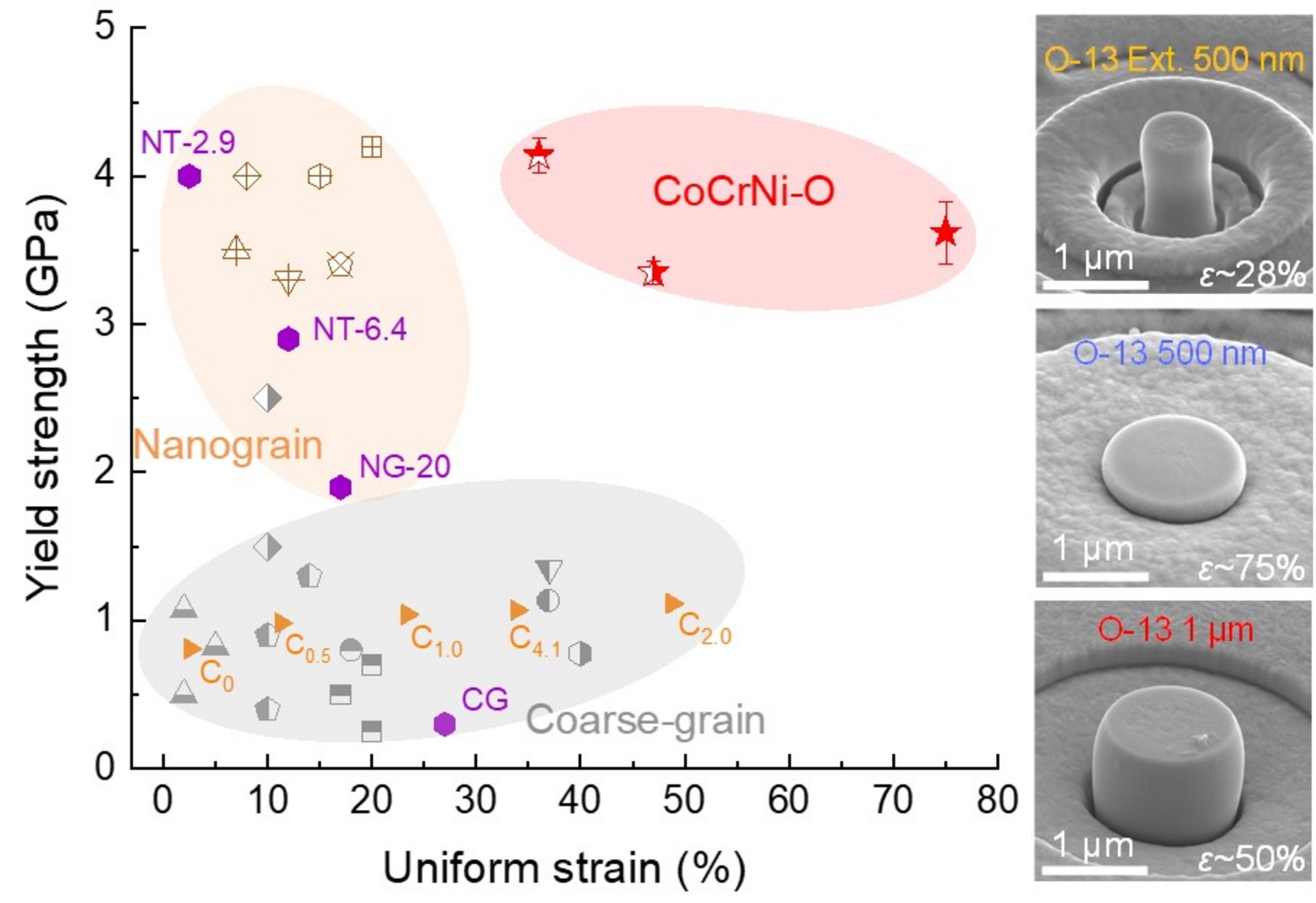
In the world of nanometals, scientists have long struggled with a key limitation: although smaller grains usually strengthen materials, this trend reverses when grain sizes fall below ~10–20 nanometers. At such ultrafine scales, metals soften and become brittle, a phenomenon known as the inverse Hall-Petch effect that restricts the use of otherwise super-strong nanometals. A recent Nature Communications study by Xilei Bian and colleagues at Shanghai University, together with Daniel Şopu, Daniel Kiener and Jürgen Eckert at the Erich Schmid Institute (ESI) and the Montanuniversität Leoben, identifies oxygen nanoclusters as a potential universal solution. These clusters stabilize grain boundaries while enhancing dislocation accumulation and multiplication. This dual action enables metals with grain sizes as small as 3 nm to exhibit both ultra-high yield strength (~3.6 GPa) and large uniform plasticity (>50%). The ‘oxygen nanoclustering’ strategy appears broadly applicable, offering a powerful new pathway for designing nanometals with exceptional strength and deformability.
Further details can be found here: https://www.nature.com/articles/s41467-025-66181-1